Amateur radio station N0XMZ

The radios 
inside

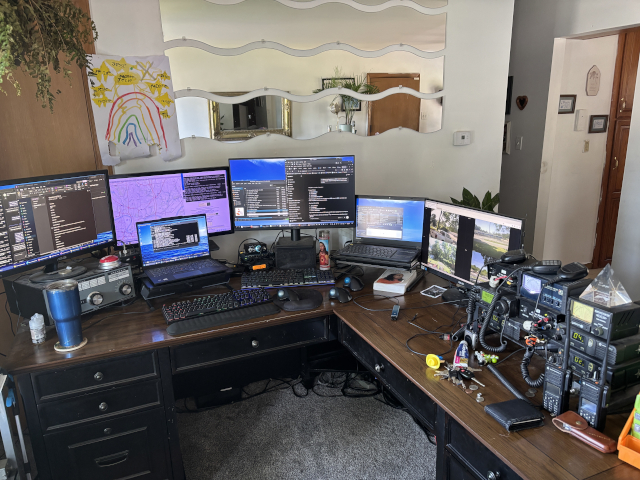
A view of the home office. There are a few computers and Raspberry Pis, all doing their thing. All machines run Kubuntu Linux except for the one I use for work.

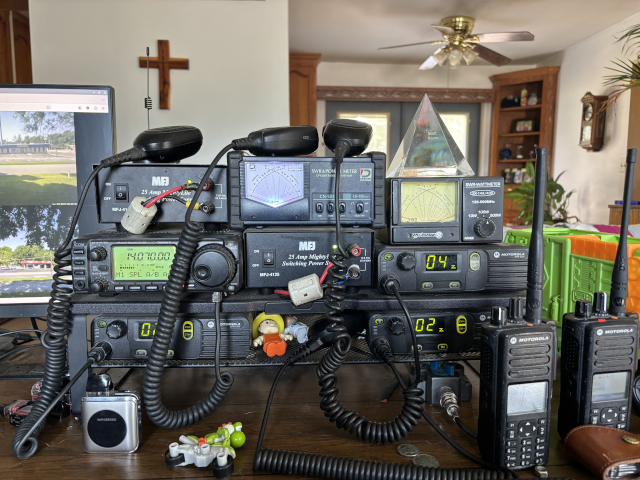
The Lord has blessed me with an Icom 706 Mk2G, (2) Motorola XPR 4350s for 2m and 70cm and an XPR 4380 for 33cm, my favorite UHF band. There are two power supplies with the Astron dedicated to the HF radio and the MFJ powering the others. It's a great little supply. I've had it in constant 24/7 operation for about 15 years now and it just keeps on keeping on. Having the Astron dedicated to the HF radio allows me to turn off the power to the radio when it's not in use. This radio has already been repaired for the infamous glue/copper trace problem. 13.8 volts is normally always present on some internal circuit even with the radio off, exasperating the problem. Both the radio and power supply have external fans I've mounted to keep them cool.

Other computers in the house work as servers and have virtual machines that do protein folding simulations for Standford University's Folding@Home distributed computing project. The project studies how proteins misfold and how that leads to diseases like Alzheimer's and cancer.

At left is part of my G5RV Jr. antenna which I use on 10 - 40m. Although it's not very high up, the performance is very good. I have it hanging between two trees and used a slingshot and rope to get it there. My method was to use a large nut for a weight, tied to a strong string. Large fishing weights work just as well. It took a lot of tries but I finally got it over a branch. I then had to climb up a ladder with my skyrake to grab the nut hanging out of reach. I tied the string to a strong rope and pulled it all the way until I could cut off the string and I had a rope hanging over the branch about 20 feet up. I repeated the process on the other end of the antenna, attached the wires to the ropes, and started pulling the ropes. Next thing you know, it's up in the clear. I weighted each end down with a gallon of water. This allows for the rope to have some give and move up or down slightly, as in a storm. That gives it strength and flexibility. I like to use clothesline rope from Ace Hardware. It's strong, fairly smooth (for going over branches) and stands up under harsh weather.

There were some times I got a rope stuck in a tree or needed to grab the weight on the rope with something longer than I can reach so I duct-taped this rake to the end of a 10' section of conduit. On a ladder, I was able to clear most snags. When larger branches got in the way, I cut them down with a saw. I call this contraption the "skyrake" (pictured below with my dog Rocky).

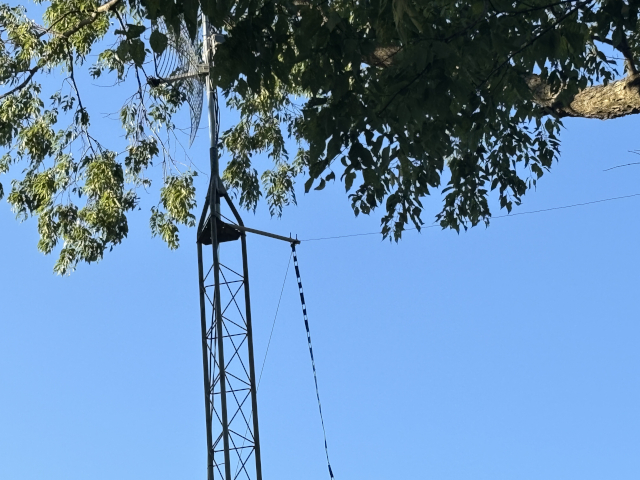
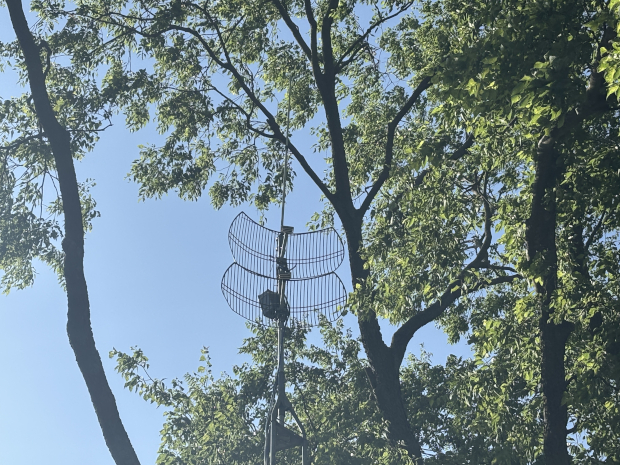
Below is my small antenna farm on the roof. In this view, the 2.4 GHz antennas take center stage with a dual-band Comet GP-6 for 2m/70cm right behind it. The 2.4 GHz antennas have 24 dBi gain so with 100 mW, I should get an ERP of around 25 watts. In the box is a new Mikrotik ac3 router that runs AREDN Mesh software. I hope to make a MESH connection, I just need a target!

The Comet has 6.6 dBi gain on VHF and 9 dBi on UHF. Underneath the parabolas is a Maxrad 6-element yagi for 900 MHz, rated at 11 dBi. The 900 MHz vertical is a Comet GP-20, a collinear rated at 8 dBi. span class="image-left">img src = "image/microwave2.jpg">

The radios inside

A close-up of the radios. Icom IC-706 MK2G, the 3 units for V/UHF FM, my trusty oscilloscope and barely visible is the small black TinySA Ultra Plus spectrum analyzer and signal generator. My how times have changed. About 20 years ago, a new digital scope would easily be around $1k and even more for the spectrum analyzer. I spent a total of about $375 for these two units.

Below that pioc is my Icom IC-207 for that serves as an APRS digipeater/gateway along with the Raspberry Pi right next it that also runs fldigi via a remote desktop connection as the pi itself runs headless.
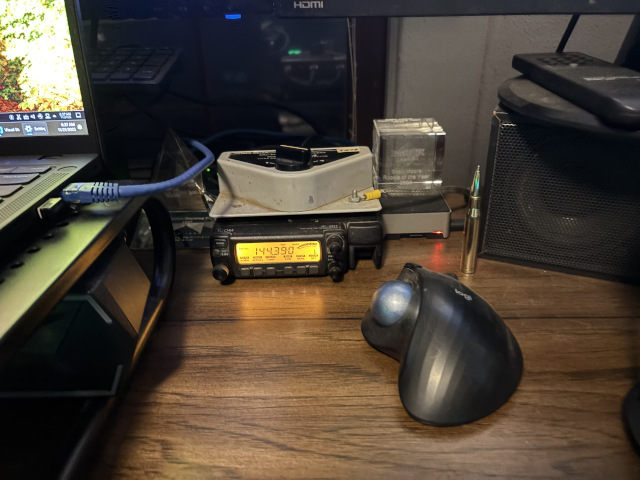
There are a few 900 MHz repeaters in town but almost no one on them. I've made it a personal crusade to get more people on 900. It's a fun band! It's very much like 70cm in terms of propagation. You won't find ham gear for 900 except for some old Icoms and Alincos but good luck finding them. Most of us use commercial radios made by Motorola and Kenwood. Some of them, like the old Spectras, require hardware mods in addition to software hacking. Thankfully, no hacking is required with the right versions of the MTX-4350 2m/70cm radios, the Mototrbo CPS is happy to take amateur frequencies. The 900 MHz verion, the XPR 4380, requires in-memory hex-editing (aka "bit-banging") to set amateur frequencies.
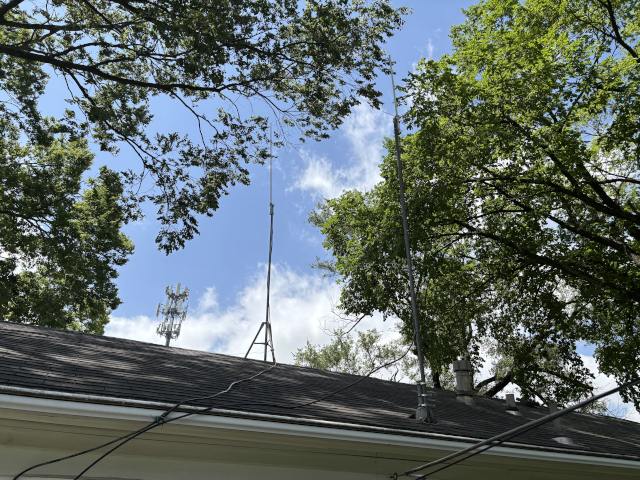
The pic below is a closeup of the Heathkit legal-limit tuner I scored for $150, my trusty MFJ Antenna Analyzer (a must-have for any ham), and my Motorola XPR 7550 HTs that cover 2m and 70cm on analog and DMR. My DMR ID is 3213607.